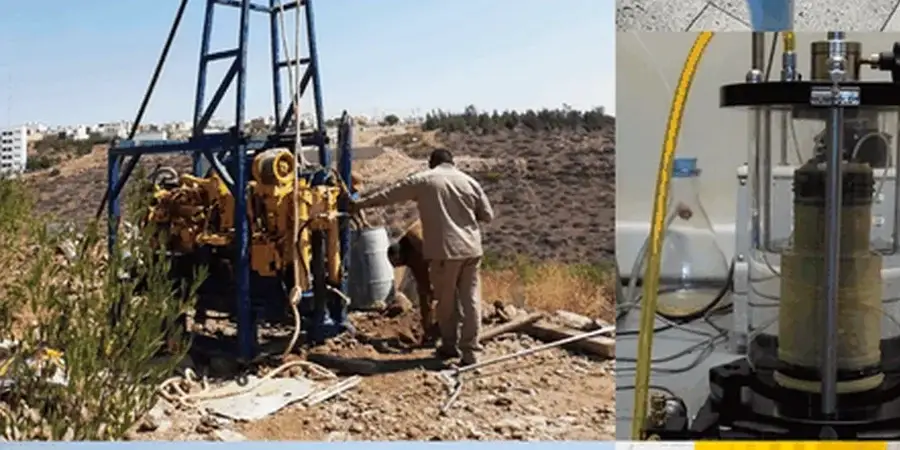
Tampa’s growth from a 19th-century phosphate shipping port into a modern Gulf Coast metropolis brought with it a set of unique geotechnical challenges that still define local construction today. The shallow limestone bedrock and overlying sandy soils that made early excavation difficult now require precise analysis to prevent differential settlement and sinkhole formation. A thorough soil mechanics study in Tampa must account for these karst features, along with the high water table that sits just a few feet below surface grade across much of Hillsborough County. Our laboratory applies ASTM D2487 classification protocols and drained triaxial shear testing to give structural engineers the parameters they need for foundation design. For projects near the bay, where soft organic silts complicate bearing capacity calculations, we often pair laboratory index testing with field programs like CPT testing to develop a continuous subsurface profile without the disturbance that traditional sampling introduces.
In Tampa's karst terrain, a soil mechanics study that ignores the collapse potential of the transition zone between sand and limestone is just a preliminary screening, not an engineering deliverable.
Our approach and scope
Site-specific factors
Tampa sits squarely in Florida's Sinkhole Alley, and the underlying limestone of the Floridan Aquifer system dissolves slowly over time, creating cavities that can lead to sudden ground collapse. A 2021 event in the Seffner area, just east of the city limits, opened a 20-foot-wide depression that swallowed part of a residential street, underscoring the risk that property developers and civil engineers face throughout the Tampa Bay region. The Florida Geological Survey maintains a database of reported sinkholes that shows a clear concentration along the Interstate 4 corridor, where our firm has conducted numerous subsurface investigations. A proper soil mechanics study in this environment includes ground penetrating radar or electrical resistivity profiling to locate anomalies, followed by targeted borings to verify cavity depth and roof thickness. Leaving these features undetected during the design phase can result in structural distress that appears within the first five years of building service life.
Reference standards
ASTM D2487: Standard Practice for Classification of Soils for Engineering Purposes (Unified Soil Classification System), ASTM D1586: Standard Test Method for Standard Penetration Test (SPT) and Split-Barrel Sampling of Soils, ASCE 7: Minimum Design Loads and Associated Criteria for Buildings and Other Structures, IBC Chapter 18: Soils and Foundations (current Florida Building Code edition)
Other technical services
Foundation Analysis and Bearing Capacity
We calculate net allowable bearing pressure using both shear failure criteria and settlement limits, applying Vesic's bearing capacity factors with shape and depth corrections appropriate for strip, spread, and mat foundations on Tampa's layered sand-limestone profile.
Sinkhole and Karst Feature Investigation
Our field crews execute SPT borings with rock coring through suspected cavity zones, log the recovered core for dissolution features, and prepare a geotechnical report that addresses the Florida Statute 627.706 sinkhole investigation requirements for insurance and structural remediation planning.
Typical parameters
Common questions
What does a soil mechanics study cost in Tampa?
For a standard residential or light commercial parcel in Hillsborough County, the fee typically runs between US$3,280 and US$5,180. The final amount depends on the number of borings, the depth to competent bearing stratum, and whether sinkhole investigation protocols must be included per the Florida Building Code.
How deep are the borings for a typical Tampa soil mechanics study?
Borings generally extend to a minimum of 20 feet below the planned footing elevation, or until competent limestone is encountered and cored for at least 10 feet. In areas with documented sinkhole activity near the Interstate 4 corridor, we often deepen the investigation to 40 feet or more to confirm that no large cavities exist beneath the zone of influence of the proposed foundation.
Which laboratory tests are essential for Tampa's sandy soils?
Grain size distribution by sieving and hydrometer, Atterberg limits on the fines fraction, and direct shear or triaxial compression tests on remolded specimens are the core suite. When the stratigraphy includes the plastic clays of the Hawthorn Group, we add one-dimensional consolidation testing because these materials can produce significant long-term settlement even under moderate foundation loads.