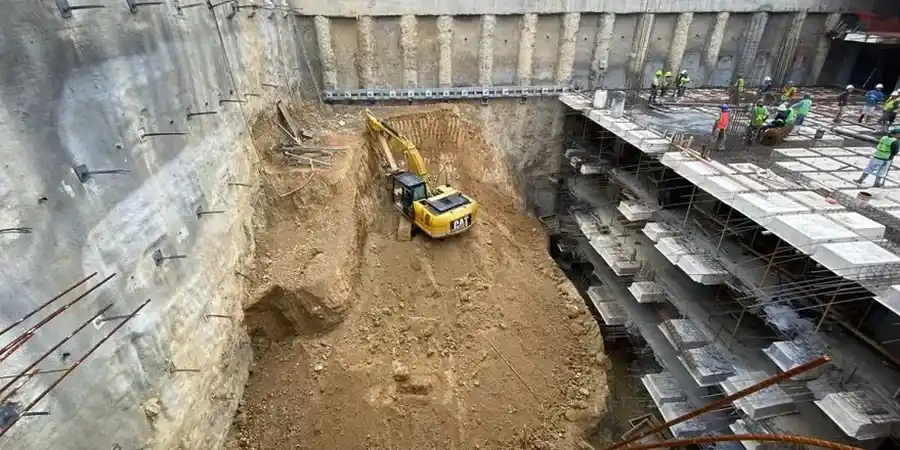
Tampa’s vertical growth—from the historic red brick of Ybor City to the glass towers reshaping the Channel District—has always contended with a subsurface that offers few easy answers. Beneath the surface, the Hawthorne Group’s interbedded clays and the underlying Ocala Limestone create a karstic sequence where solution cavities, pinnacles, and a fluctuating Floridan aquifer water table turn a straightforward cut into a real exercise in geotechnical design of deep excavations. In our track record supporting projects from Westshore to downtown, the combination of low-cohesion overburden sands and highly variable limestone top-of-rock demands a design approach that reconciles three competing forces: basal stability against cavity collapse, hydraulic uplift during the rainy season, and lateral support for adjacent structures that often sit on shallow spread footings. Understanding how the Tampa Limestone member weathers at depth—and where relic sinkholes filled with soft organic silt may lurk—shapes the entire excavation support scheme before the first bucket of soil is removed.
In Tampa’s karst, a deep excavation is less a hole in the ground and more a temporary restructuring of the aquifer—get the hydrogeology right, and the soil mechanics will follow.
Our approach and scope
Site-specific factors
One thing we see repeatedly in Tampa is that the real trouble doesn't show up during the excavation—it shows up weeks later, after the first sustained rainfall event. A cut that looked perfectly stable in dry sand can transition rapidly when a storm surge from Tampa Bay—or even a routine summer thunderstorm dropping two inches in an hour—recharges the water table faster than the dewatering system can respond. The biggest risk vector isn't wall deflection; it's internal erosion at the subgrade level where water seeps through an undetected karst conduit, carrying fine sand with it and creating a void that migrates upward toward the pavement. We have also encountered cases where a limestone pinnacle was misinterpreted as the regional top-of-rock, leading to an excavation that was founded on a narrow bridge of competent rock surrounded by soft, solution-weathered material—a setup for differential settlement that no amount of compaction grouting can fully remediate. The liquefaction potential in Tampa's loose, saturated fill zones during a distant seismic event is low but not zero, and for critical infrastructure we often run a simplified Seed-Idriss check to rule out any surprises.
Reference standards
Florida Building Code, Building (2023, 8th Edition) – Chapter 33 (Excavations and Foundations), ASCE/SEI 7-22 – Minimum Design Loads for Buildings and Other Structures, Section 3.2 (Earth Pressure), ASTM D1586 / ASTM D2487 – Standard Penetration Test and Soil Classification (used for overburden characterization), FHWA GEC No. 4 – Ground Anchors and Anchored Systems (rock socket design in limestone)
Other technical services
Anchored Soldier Pile & Lagging Design
We develop site-specific wall sections with tieback placement optimized around the Hawthorne confining layer. Bond lengths are verified through rock coring, and each anchor is designed for the aggressive corrosion environment of Tampa's saline groundwater.
Pumping & Dewatering Integration
The design coordinates the structural wall with a perimeter deep-well system, sized using hydraulic conductivity values from field falling-head tests. We model the radius of influence to predict off-site settlement in adjacent neighborhoods like Hyde Park.
Karst Feature Mitigation Planning
When CPT probing identifies a potential cavity beneath the excavation footprint, we design a staged grouting program using low-mobility mixes to fill the void without pressurizing the karst conduit and triggering a collapse elsewhere on site.
Typical parameters
Common questions
How much does geotechnical design for a deep excavation typically cost in Tampa?
For a commercial or mixed-use project in Tampa with excavation depths between 15 and 30 feet, the combined scope of subsurface exploration, laboratory testing, and preparation of signed-and-sealed support-of-excavation drawings generally falls between US$2,250 and US$8,790. The range depends on the number of borings, the need for rock coring, and the complexity of tieback testing.
What makes karst geology in Tampa different from other Florida cities for deep excavation design?
Tampa sits on the Ocala Limestone, which is older and more weathered than the Miami Limestone to the south. This means more pinnacled rockhead, deeper solution pipes, and a thicker overburden of Peace River Formation clay that can mask cavities. The design has to handle abrupt vertical changes in bearing capacity within a single excavation footprint.
How do you handle tieback anchors in Tampa's limestone when sinkhole risk is present?
We never assume a uniform bond zone. Each tieback row is designed after a targeted rock coring program that maps the rock quality designation (RQD) along the anchor path. In zones where the RQD drops below 25%, we extend the bond length or shift to a gravity wall alternative to avoid relying on fractured, cavity-prone rock.