Tampa sits just 48 feet above sea level on a limestone backbone that shakes differently than Miami or Jacksonville. The last significant rumble came from a 5.9 magnitude Gulf event in 2006, but the real conversation here isn't about when the next one hits—it's about what happens to your operating income when the building still works the morning after. Base isolation seismic design isn't a code checkbox for us. We apply it to cut inter-story drift by 60 to 80 percent compared to fixed-base structures, using lead-rubber and friction pendulum systems calibrated to the short-period amplification we see in Hillsborough County's stiff near-surface soils. When the owner of a four-story medical office near downtown asked us to protect surgical suite uptime, the numbers drove the decision: a base isolation seismic design solution added roughly 3 percent to structural cost and eliminated weeks of potential downtime modeled under the ASCE 7-22 design basis earthquake. That math holds up whether you're building on the Hawthorn Group clays north of I-4 or on the karst-influenced deposits closer to the bay. Before we lock in isolator properties, we typically run a CPT test to nail down the shear wave velocity profile without the disturbance you get from SPT sampling—especially critical where the limestone surface is irregular. And for projects with deep foundations, the isolator performance depends heavily on the pile cap stiffness, so we model both together early in schematic design.
The isolator period has to sit above the site's predominant period—but only if the substructure doesn't introduce its own flexibility.
Our approach and scope
- Site-specific response spectra developed from deep shear wave velocity profiles—no generic Site Class D assumptions.
- Prototype isolator testing to ISO 22762 standards, verifying effective stiffness and damping across three cycles at design displacement.
- Wind load checks to ensure the isolation system doesn't activate under hurricane gusts, since Tampa's wind exposure can govern the isolator yield force.
Site-specific factors
Compare two sites we evaluated last year: one in Ybor City on dense, cemented sands where ground motions amplify in the 0.2-second range, and another in South Tampa on softer organic silts where the site period stretches past 0.6 seconds. Same magnitude event, completely different spectral demands at the isolator level. The Ybor City structure required a higher yield force to stay locked under wind, while the South Tampa building needed more displacement capacity because the longer site period pushed the isolator into higher equivalent damping. When owners skip base isolation seismic design or try to adapt a California cookie-cutter solution, they miss this: Tampa's soil profile—stiff near-surface limestone underlain by variable Hawthorn Group sediments—produces ground motions with a distinct high-frequency kick that fixed-base structures amplify floor by floor. The isolator decouples the structure from that kick, but the decoupling only works if the moat walls are actually wide enough and the utility connections—chilled water, medical gas, electrical busways—are designed with flexible loops rated for the full MCE displacement. We've seen retrofit projects where undersized moats would cause pounding at 70 percent of design displacement. That's a functional failure, not a structural one, but it closes the building either way.
Reference standards
ASCE 7-22 Minimum Design Loads and Associated Criteria for Buildings and Other Structures, IBC 2021 (Florida Building Code adopted edition), ISO 22762 Elastomeric seismic-protection isolators, ASTM D7400 / D7400M Standard Test Methods for Downhole Seismic Testing
Other technical services
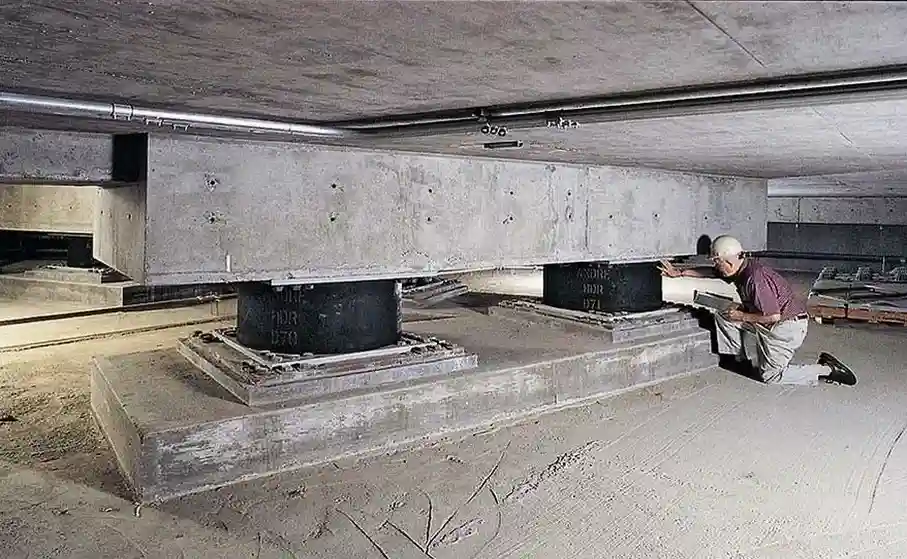
Elastomeric isolator design
Lead-rubber and high-damping rubber bearing systems designed per ISO 22762, with bilinear properties calibrated to Tampa site spectra. We size the lead core for wind restraint and the rubber layers for MCE displacement plus aging and scragging effects.
Friction pendulum system design
Single, double, and triple pendulum isolators with effective radii tuned to the target isolation period. We model the velocity-dependent friction coefficient explicitly in the nonlinear time-history analysis and specify the stainless steel-concave surface testing protocol.
Superstructure and moat interface design
Coordination of isolator pedestals, moat cover detailing, and flexible utility loops for plumbing, fire protection, medical gas, and electrical systems. We deliver the displacement envelopes that the MEP engineers need to size expansion joints and flexible couplings correctly.
Typical parameters
Common questions
What does base isolation seismic design cost for a Tampa commercial building?
For a mid-rise critical facility in Hillsborough County, the structural premium typically ranges from US$3,960 to US$8,920 above conventional seismic design, depending on the isolator type, number of units, and prototype testing scope. That figure covers isolator devices, pedestals, moat construction, and the additional analysis effort. The real comparison is against post-earthquake downtime: for a hospital generating $500,000 daily in revenue, even a two-week closure dwarfs the isolation investment.
How does Tampa's limestone geology affect isolator performance?
The stiff limestone near the surface transmits high-frequency ground motions efficiently, which means fixed-base structures see strong floor accelerations. Base isolators shift the structure's period to 2.5-3.5 seconds, well above the site's predominant period, so the acceleration demand drops significantly. The key is verifying that the limestone doesn't have solution cavities under the isolator pedestals—we use CPT soundings and cross-hole seismic testing to confirm bearing integrity before finalizing the pedestal design.
Does the Florida Building Code require base isolation?
The Florida Building Code (based on IBC 2021) does not mandate base isolation for most structures, but ASCE 7-22 Section 17 provides the design requirements when it is chosen as the seismic force-resisting system. For Risk Category IV facilities like hospitals and emergency response centers, base isolation becomes an attractive option because it directly addresses the functional recovery objective that conventional fixed-base designs struggle to meet under MCE-level shaking.
How do you test isolators before installation in Tampa?
We specify prototype testing per ISO 22762, which requires three fully reversed cycles at design displacement plus aging and temperature conditioning. Production tests on every isolator verify effective stiffness and equivalent damping at the design displacement. For friction pendulum systems, we test the breakaway friction coefficient under the actual bearing pressure the isolator will see. All testing is witnessed by our team or an independent testing agency before the isolators ship to the Tampa site.