Tampa's transformation from a sparsely populated fishing village in the 1880s to a sprawling metropolitan area of nearly 400,000 residents has placed immense demand on its underlying soils. The discovery of phosphate in the late 19th century triggered an industrial boom, and the subsequent construction of bridges, causeways, and high-rise condominiums along the Hillsborough River and Tampa Bay shoreline has continuously challenged geotechnical engineers. Much of downtown Tampa sits on sandy deposits interbedded with silty and clayey layers, remnants of ancient marine terraces shaped by Pleistocene sea-level fluctuations. When a structural engineer needs to model foundation behavior for a new tower in Channelside or a deep excavation in Ybor City, basic index tests are insufficient. The triaxial test provides the precise drained and undrained shear strength parameters required to predict how these complex Tampa soils will respond under load, allowing our laboratory to generate site-specific failure envelopes critical for designs that must contend with both soft ground and the region's ever-present hurricane-driven groundwater fluctuations.
Accurate shear strength parameters from a triaxial test can prevent over-excavation costs exceeding six figures on a single deep foundation project in Tampa's variable coastal plain soils.
Our approach and scope
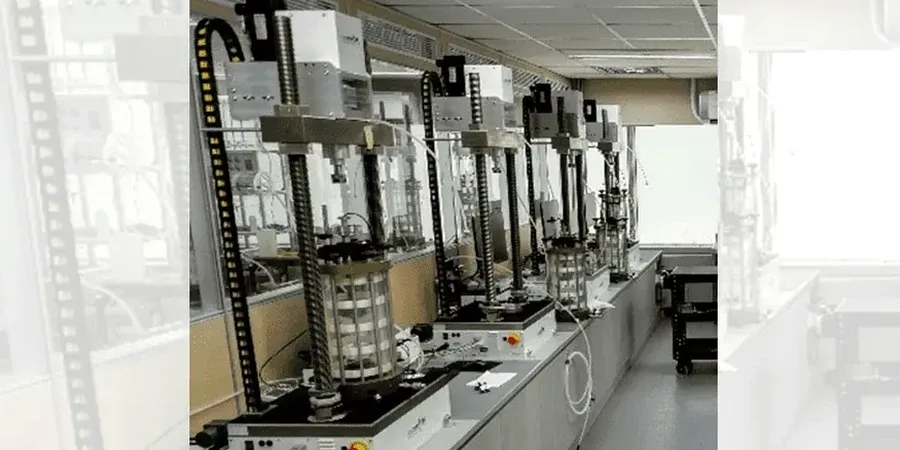
Site-specific factors
Comparing two distinct Tampa neighborhoods illustrates the risk of relying on regional assumptions instead of site-specific triaxial data. Davis Islands, constructed from dredged fill in the 1920s, consists of loose to medium-dense sand with silt pockets that are highly susceptible to liquefaction and bearing capacity failure under seismic loading. In contrast, the areas north of Busch Boulevard transition into well-graded sands and stiff clays with significantly higher penetration resistance. A developer who assumes the same undrained shear strength for both zones courts disaster. On Davis Islands, a structure founded without verifying the effective stress friction angle from a triaxial test could track record differential settlement exceeding 1.5 inches over a 20-year period, cracking slabs and rupturing utility connections. The IBC and ASCE 7 explicitly require site-specific shear strength determination for seismic site class evaluation, and the triaxial test remains the only reliable method to quantify how these loose, saturated Tampa sands lose strength when rapidly loaded during a hurricane or distant seismic event.
Reference standards
ASTM D4767 (CU Triaxial), ASTM D2850 (UU Triaxial), IBC 2021, ASCE 7-22
Other technical services
Consolidated-Undrained (CU) Triaxial
The most requested configuration for Tampa projects. We saturate the specimen under back-pressure, consolidate to the estimated in-situ effective stress, and shear at a slow rate while measuring pore pressure. This yields effective stress parameters (c' and φ') for long-term slope stability and drained foundation analysis.
Unconsolidated-Undrained (UU) Triaxial
A rapid test for cohesive soils where we apply confining pressure and shear the specimen without allowing drainage or consolidation. The result provides the undrained shear strength (cᵤ) for short-term construction conditions, such as evaluating the stability of a temporary excavation in Tampa's clay layers.
Consolidated-Drained (CD) Triaxial
Performed at very slow strain rates to allow complete pore pressure dissipation throughout the test. This determines the true drained friction angle (φ') for coarse-grained soils and is specified when analyzing long-term settlement and bearing capacity for embankments on Tampa's sandy deposits.
Typical parameters
Common questions
What is the typical cost for a triaxial test program on a Tampa project?
A single triaxial test typically ranges from US$1.790 to US$2.580, depending on whether it is a UU, CU, or CD procedure and the number of confining pressures required to construct a failure envelope. A full program with three specimens tested at different confining stresses generally falls at the upper end of that range per setup.
How do Tampa's high groundwater levels affect triaxial test procedures?
Since the water table in much of Tampa lies within 5 to 10 feet of the surface, most undisturbed samples arrive fully saturated. We employ back-pressure saturation to dissolve any air introduced during sampling, verifying the Skempton B-value exceeds 0.95 before shearing. This reproduces the submerged, saturated state that governs foundation design in coastal Florida.
What sample quality is required for a reliable triaxial test?
We require undisturbed samples obtained with thin-walled Shelby tubes or piston samplers, with a minimum diameter of 2.8 inches. Highly disturbed or remolded samples produce unreliable effective stress parameters. For cohesionless Tampa sands, frozen sampling or reconstituted specimens prepared to the field density may be necessary to preserve the natural structure. More info.