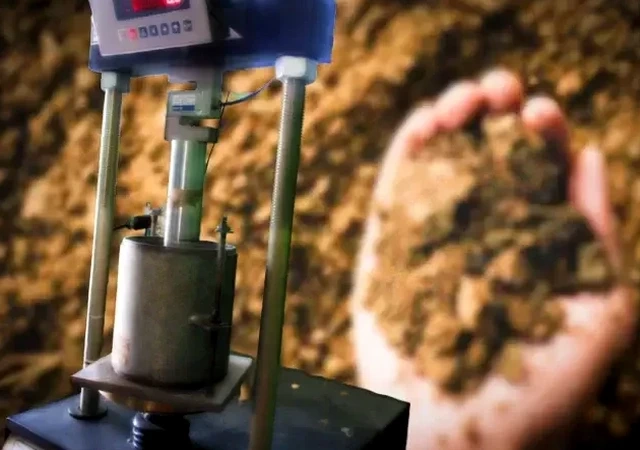
Tampa’s road network expanded dramatically after the 1950s, when the interstate system pushed through Florida’s karst terrain. Designing pavements here means confronting what lies beneath the asphalt: loose sands, pockets of organic silt, and weathered limestone that varies from block to block. The laboratory CBR test gives engineers a direct measurement of subgrade strength under controlled moisture conditions—something field tests alone cannot replicate. For projects in Tampa, where the water table often sits less than five feet below the surface, soaked CBR values are the standard input for flexible pavement thickness design per AASHTO 1993. Our team runs the triaxial compression test on companion samples when shear strength parameters are needed for mechanistic-empirical design, and we pair the CBR data with grain-size analysis to confirm the Unified Soil Classification of the subgrade before the asphalt goes down.
A soaked CBR of 3 percent versus 8 percent can mean the difference between 6 inches and 12 inches of asphalt—and a million dollars in Tampa pavement costs.
Our approach and scope
Site-specific factors
Subgrade conditions vary sharply between Tampa neighborhoods. In New Tampa, where the underlying Hawthorne Formation brings clayey sands closer to the surface, we often see soaked CBR values hold above 8 percent with moderate compaction. Drive ten miles south to the Westshore business district, and the reclaimed marsh deposits push soaked CBR below 3 percent—a subgrade that will pump and rut within two years under truck traffic if the pavement section is not thickened or chemically stabilized. The biggest mistake we see is designing with unsoaked CBR values. Florida’s perched water table, fed by summer rains and storm surge, saturates the subgrade to equilibrium within months of construction. A pavement designed on an optimistic CBR of 15 percent that drops to 4 percent after saturation will track record premature fatigue cracking and subgrade rutting that no overlay can fix.
Reference standards
ASTM D1883-21 – California Bearing Ratio (CBR) of Laboratory-Compacted Soils, ASTM D1557-12(2021) – Modified Proctor Compaction, AASHTO T 193 – CBR of Laboratory-Compacted Soils, Florida DOT Specification Section 160 – Subgrade and Base Materials
Other technical services
Soaked CBR Testing for FDOT Pavement Design
Three-point compaction and 96-hour soaking per AASHTO T 193 and ASTM D1883, with swell measurement and corrected penetration curves. Includes moisture-density relationship, CBR at 0.1-inch and 0.2-inch penetration, and recommendations for subgrade stabilization if values fall below FDOT minimums.
Atterberg Limits and Soil Classification Suite
Liquid limit, plastic limit, and plasticity index determination per ASTM D4318, paired with sieve analysis and hydrometer testing for full USCS classification. Required documentation for any Tampa pavement project where the subgrade contains more than 12 percent fines.
Typical parameters
Common questions
How much does a laboratory CBR test cost in Tampa?
A standard soaked CBR test with three-point compaction runs between US$120 and US$230 per sample, depending on whether companion Atterberg limits and gradation testing are bundled. Projects requiring multiple samples from different subgrade zones typically qualify for volume pricing.
Why is the CBR sample soaked for 96 hours before testing?
The 96-hour soaking period specified by ASTM D1883 simulates the long-term saturated condition that subgrade soils reach in Florida’s high-water-table environment. Unsoaked CBR values can be misleadingly high for Tampa’s sandy soils, where seasonal saturation reduces bearing capacity significantly.
What is the difference between lab CBR and field CBR for Tampa projects?
Laboratory CBR tests compacted samples at controlled moisture and density, giving a repeatable baseline for pavement thickness design. Field CBR measurements on in-situ soil capture natural variability in moisture and density but lack the controlled saturation simulation. FDOT pavement design typically uses soaked lab CBR values as the primary input.
How many CBR samples are needed for a typical Tampa commercial site?
A standard commercial site of one to five acres typically requires one CBR sample per distinct subgrade zone, with a minimum of three samples per soil type encountered. Larger projects like residential subdivisions or roadway corridors may require one sample every 500 to 1,000 linear feet along the alignment.
What CBR value does FDOT require for subgrade acceptance?
Florida DOT Specification Section 160 generally requires a minimum soaked CBR of 8 percent for subgrade soils supporting flexible pavement. Values below 8 percent trigger stabilization requirements—typically lime or cement treatment—or an increase in the structural number of the pavement section to compensate for the weaker subgrade.