A crawler-mounted drill rig advances a hollow-stem auger through loose surface sand, pausing every five feet to drive a split-spoon sampler under a 140-pound hammer falling 30 inches. The blow counts logged on that rig are the starting point for every shallow foundation design we evaluate in the Tampa Bay area. The city sits on a layered sequence of Pleistocene sand, silty clay, and weathered limestone caprock, meaning bearing capacity can shift from adequate to borderline within a single lot. Our team analyzes SPT data, lab classification, and Karst hazard maps to size footings that work with the stratigraphy rather than against it. For sites where the upper five feet show variable density, we often recommend supplementing the standard penetration test with a plate load test to directly measure deformation modulus before finalizing footing dimensions.
Tampa's karst geology demands that shallow foundation design account for both bearing failure and the risk of cover-collapse sinkholes beneath uniformly loaded footings.
Our approach and scope
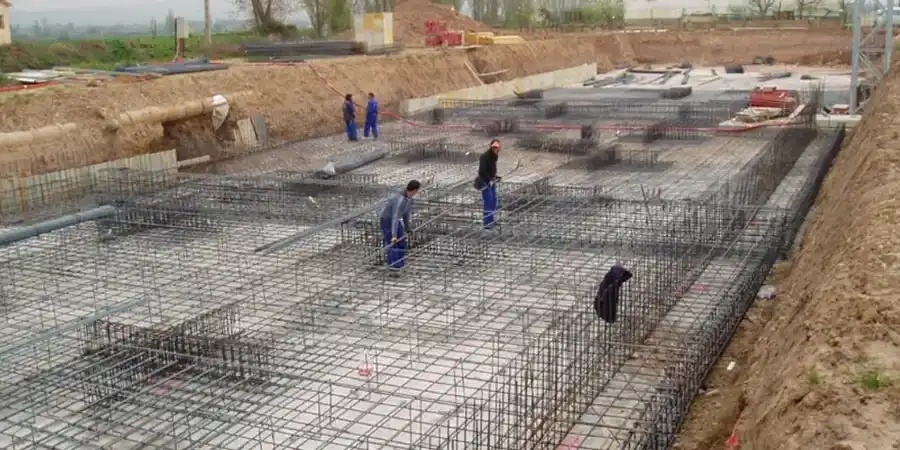
Site-specific factors
A warehouse designed for sandy flatwoods near New Tampa encounters a completely different bearing stratum than a three-story apartment in the clay-rich soils of the Interbay peninsula. In New Tampa, clean quartz sand often delivers N60 values above 20 by a depth of four feet, and settlement is primarily elastic and immediate. In South Tampa, buried organic silt and plastic clay layers can compress for months under load, causing differential movement that cracks masonry and binds doors. The most expensive mistake we see is treating the entire city as a uniform pad: a footing sized for sand fails on clay, and a footing sized for clay triggers over-excavation costs on sand. We also evaluate sinkhole proximity using Florida Geological Survey data: a shallow foundation within a mapped Karst depression requires either geogrid-reinforced subgrade or an engineered fill pad compacted to 95% of modified Proctor density before concrete is poured.
Reference standards
IBC 2021 (Florida Building Code 8th Edition) Chapter 18: Soils and Foundations, ASCE 7-22 Minimum Design Loads and Associated Criteria for Buildings and Other Structures, ASTM D1586 Standard Test Method for Standard Penetration Test (SPT) and Split-Barrel Sampling of Soils, ASTM D2487 Standard Practice for Classification of Soils for Engineering Purposes (Unified Soil Classification System), Florida Building Code Section 1810: Sinkhole Activity and Foundation Design Requirements
Other technical services
Spread Footing Design
Sizing and reinforcement for isolated and combined footings based on SPT, CPT, and lab shear strength data. Includes punching shear check and flexural design per ACI 318.
Mat Foundation Analysis
Finite element modeling of raft slabs where soil bearing capacity is low or column loads are high. We use modulus of subgrade reaction derived from plate load tests or corrected SPT correlations.
Settlement Monitoring Plans
Instrumentation layout and reading schedules for structures on compressible soils. Optical survey points and settlement plates tracked through the critical loading period.
Sinkhole Risk Mitigation
Subsurface grouting plans and geogrid-reinforced engineered fill pads designed for foundations located within mapped Karst depressions or near historical sinkhole activity.
Typical parameters
Common questions
How much does shallow foundation design cost for a typical Tampa residential lot?
For a single-family home on a standard lot in Hillsborough County, a complete shallow foundation design package including soil borings, lab testing, and the engineering report typically ranges from US$1,890 to US$2,750. The final cost depends on the number of borings required, the depth to competent bearing stratum, and whether sinkhole investigation is needed.
What makes Tampa's soil challenging for shallow foundations?
Tampa's subsurface is a mix of Pleistocene sand, pockets of organic silt and clay, and an irregular limestone caprock surface. The water table is high, often three to six feet below grade, and the region has active Karst geology with cover-collapse sinkholes. These conditions require careful bearing capacity verification and settlement analysis that accounts for both immediate elastic compression and longer-term consolidation in clay lenses.
Do I need a shallow foundation design if I am building a small addition?
Yes, even small additions require a foundation that matches the existing structure's performance. Differential settlement between old and new footings is a common source of cracking in Tampa homes. A geotechnical investigation with at least one boring and a design memo from a licensed engineer satisfies the Florida Building Code requirements and protects the investment.