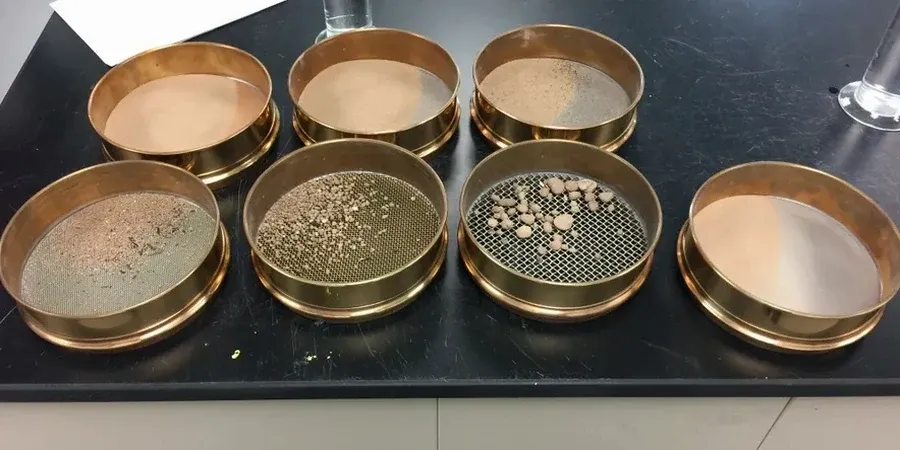
In Tampa, the soil profile often surprises you. You start with surface sand and within a few feet hit silty clay or organic layers from old mangrove swamps. That mix makes a standard sieve alone insufficient. You need the full hydrometer analysis to capture the silt and clay fraction—anything less and the USCS classification is just a guess. Our lab processes hundreds of Tampa samples annually, running ASTM D422 for the coarse fraction and ASTM D7928 hydrometer for the fines. We correlate results with Atterberg limits when plasticity is in play, and for road subgrade projects near I-4 or the Selmon Expressway, the gradation ties directly into CBR road design parameters. Report turnaround is typically 3 business days.
A complete particle size distribution curve—from coarse sand to colloidal clay—is the single most cost-effective data point for predicting Tampa soil behavior.
Our approach and scope
Site-specific factors
The Florida Building Code (FBC 2023, based on IBC) references ASTM D2487 for soil classification, which depends entirely on grain size distribution and Atterberg limits. A misclassification of silty sand as sandy silt flips the foundation design assumptions—bearing capacity, settlement, and drainage characteristics all change. In Tampa's karst-influenced terrain, fines content also controls the risk of internal erosion into limestone cavities. The USCS group symbol on your boring log carries legal weight; if it's wrong and a retaining wall fails along the Hillsborough River floodplain, the geotechnical report is the first document subpoenaed. We run duplicate hydrometer tests on every sample with more than 12 percent passing the No. 200 sieve to verify the clay fraction.
Reference standards
ASTM D422 - Standard Test Method for Particle-Size Analysis of Soils, ASTM D7928 - Standard Test Method for Particle-Size Distribution (Gradation) of Fine-Grained Soils Using the Sedimentation (Hydrometer) Analysis, ASTM D2487 - Standard Practice for Classification of Soils for Engineering Purposes (Unified Soil Classification System), AASHTO T 88 - Particle Size Analysis of Soils, Florida Building Code (FBC) 2023, Chapter 18
Other technical services
Full Sieve + Hydrometer Package
Combined ASTM D422 and D7928 analysis from coarse gravel to colloidal clay. Includes percent passing table, grain size curve, and USCS classification with group symbol and group name.
Wash Sieve Only (No. 200)
For clean sands where the fines percentage is the only question. We oven-dry, wash, re-dry, and report percent passing No. 200. Useful for concrete aggregate compliance checks at Tampa ready-mix plants.
Hydrometer Only (Fine Fraction)
Sedimentation analysis on the minus No. 200 material when the coarse fraction is already characterized. Includes temperature-corrected readings at 0.5, 1, 2, 5, 15, 30, 60, 240, and 1440 minutes.
Typical parameters
Common questions
How much does a grain size analysis cost for a single Tampa sample?
For a combined sieve plus hydrometer analysis, the cost ranges from US$110 to US$160 per sample, depending on whether we need to run Atterberg limits in parallel for a complete USCS classification.
What sample mass do you need for the hydrometer test?
We need a minimum of 200 grams of the minus No. 10 fraction for fine-grained soils. For sandy soils we prefer 500 grams from the composite sample. The material must be oven-dried and pulverized gently to break down clods without crushing individual particles. If you are shipping from a Tampa drill site, double-bag the sample—the humidity here causes condensation inside single bags.
How long does the sedimentation hydrometer test take?
The full hydrometer run spans at least 24 hours from the moment we add the dispersing agent. We take readings at specified intervals: 0.5, 1, 2, 5, 15, and 30 minutes, then 1, 2, 4, and 24 hours. The 24-hour reading is critical for capturing the clay fraction below 2 microns. Our lab starts hydrometer tests first thing in the morning so the final reading lands during the next business day.