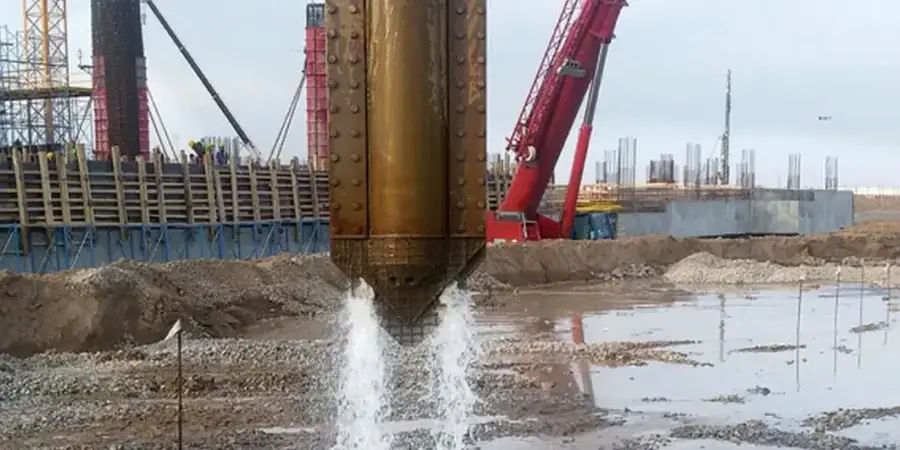
The unmistakable hum of a vibratory probe sinking into the ground marks the start of a vibrocompaction job here in Tampa. We use powerful depth vibrators, suspended from lattice-boom cranes or purpose-built rigs, that deliver horizontal vibrations while penetrating loose granular deposits. The equipment's eccentric weight assembly rotates at frequencies between 30 and 50 Hz, rearranging grain-to-grain contacts and forcing sand particles into a denser configuration. In the sandy subsurface common across Hillsborough County — shaped by ancient dune fields and marine terrace deposits — this mechanical energy propagates outward in a radial pattern that can treat zones up to ten feet from the probe. Each insertion point follows a triangular or square grid pattern calculated from site-specific energy requirements, grain size distribution, and the target relative density specified in the geotechnical baseline report.
Loose sand compacted to 70 percent relative density can mean the difference between a foundation that settles half an inch and one that settles four inches over the building's service life.
Our approach and scope
Site-specific factors
The Florida Building Code — incorporating ASCE 7-22 by reference — classifies much of coastal Tampa as Site Class D or E without ground improvement, which directly inflates seismic design coefficients even though the region's bedrock acceleration is moderate. A loose sand profile amplifies short-period spectral response and creates liquefaction susceptibility that the IBC requires engineers to evaluate for structures in Seismic Design Category C and above. Tampa sits on Pleistocene and Holocene sands that, when saturated and unimproved, can lose shear strength under cyclic loading from distant seismic events. The consequence of skipping vibrocompaction design is not just excessive settlement — it is a fundamental mischaracterization of site class that cascades into undersized foundations, noncompliant lateral systems, and insurance complications during the life of the building. Our designs close that gap by transforming the ground into a verifiable Site Class C or B material before the first yard of concrete is poured.
Reference standards
Florida Building Code (FBC) 2023 — Chapter 18 Soils and Foundations, ASCE 7-22 Minimum Design Loads and Associated Criteria for Buildings and Other Structures, ASTM D1586 Standard Test Method for Standard Penetration Test (SPT) and Split-Barrel Sampling of Soils, IBC 2021 Section 1805 — Dampproofing and Waterproofing implications for improved ground, ASTM D2487 Standard Practice for Classification of Soils for Engineering Purposes (Unified Soil Classification System)
Other technical services
Feasibility and Desktop Study
Review of existing geotechnical data, grain size curves, and groundwater records to determine whether vibrocompaction suits the site's stratigraphy before mobilizing any equipment.
Trial Compaction Program
Full-scale field test with variable spacing and energy input, including pre- and post-CPT soundings, to calibrate production parameters for the main work area.
Production Design and Grid Layout
Detailed point layout with depth targets, amperage criteria, and acceptance thresholds tied to the project's structural performance requirements.
Post-Treatment Verification Reporting
Comprehensive documentation comparing before-and-after penetration resistance, including signed and sealed engineering reports for permit closeout and the building official's records.
Typical parameters
Common questions
What does vibrocompaction design cost for a typical Tampa commercial site?
For a standard commercial lot under half an acre, the design package — including feasibility analysis, grid layout, a trial program specification, and post-treatment verification protocol — generally runs between US$1,450 and US$4,980 depending on the depth of treatment, the number of pre-design CPT soundings required, and whether a full trial compaction program is needed to satisfy the building official's review comments.
How deep can vibrocompaction effectively treat the sandy soils found in Tampa?
With conventional vibroflot equipment suspended from a crane, we routinely reach depths of 50 to 65 feet, which covers the loose Pleistocene sand layers that cause the most settlement concern in the Tampa basin. Where deeper paleochannels exist — occasionally extending to 80 or 100 feet near the bayfront — we specify extended lance configurations and tighter grid spacing to maintain energy transmission at the toe of the treatment zone.
Does vibrocompaction work when the water table is only a few feet below the surface?
The reference range for this service in Tampa is US$1.450 - US$4.980. The final price depends on the project scope and volume.
What verification testing is required after the vibrocompaction work is complete?
We typically specify a combination of CPT soundings at the centroid of the treatment grid and SPT borings at select locations to satisfy the geotechnical engineer of record. The Florida Building Code requires post-improvement testing to confirm that the actual ground conditions match the design assumptions; we recommend a minimum of one verification test per 2,500 square feet of treated area, with additional tests near the perimeter where energy dissipation is greatest.
Can vibrocompaction eliminate the need for deep foundations in Tampa's coastal zones?
In many cases, yes — particularly for mid-rise structures up to eight or ten stories with moderate column loads. Once the loose sand reaches a relative density above 70 percent, shallow spread footings often become feasible where a deep pile foundation would have been the default recommendation. Our design process includes a bearing capacity and settlement analysis comparing both options so the owner can make an informed decision based on construction schedule and budget. More info.