Tampa’s geology presents a challenge that anyone who has excavated near the bay knows well: a thick sequence of loose sands, silts, and organic layers sitting above the Hawthorne Formation limestone, with the water table often just 2 to 4 feet below the surface. When a developer proposed a five-story mixed-use building on a 2.5-acre lot off Dale Mabry Highway, the initial SPT blow counts came back at N=3 to N=6 in the upper 15 feet — classic loose-to-very-loose material with zero bearing capacity for conventional spread footings. The solution wasn't deep piles, which would have blown the budget driving through limestone floaters, but a grid of stone columns designed to densify the matrix and transfer loads to a competent bearing stratum. Our Spt Drilling data confirmed the stratification, and we modeled the column layout using the Priebe method with Tampa-specific parameters for the silty sand matrix. The result was a ground improvement scheme that raised the equivalent N-value above 18, eliminated the liquefaction trigger in the upper crust, and kept the foundation system within the owner’s cost envelope — a practical outcome that only happens when the design is anchored in local borehole reality rather than a textbook assumption.
A stone column grid engineered for Tampa’s water table and loose sands can double the bearing capacity of a site without the cost or vibration risk of driven piles.
Our approach and scope
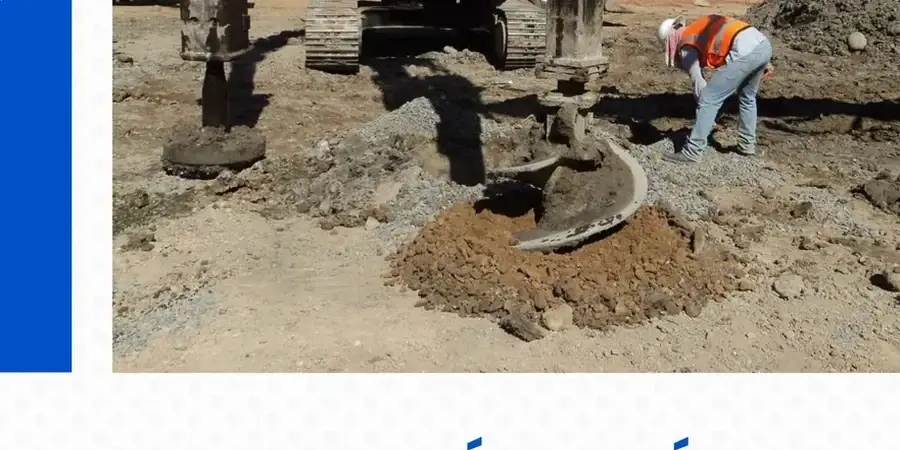
Site-specific factors
We've seen it happen twice in the last five years on Tampa sites: a contractor skips the pre-design exploratory borings, assumes a generic stone column grid will work, and ends up with a foundation that settles differentially by 2 inches in the first wet season. The failure mechanism is almost always the same — the design underestimated the thickness of the organic silt lens that nobody knew was there because nobody drilled through it. In one case near the Port of Tampa, the columns were terminated at 18 feet based on a desktop assumption, but the actual compressible layer extended to 27 feet, leaving 9 feet of untreated material under the column tips. The slab-on-grade cracked within six months, and the retrofit cost the owner more than the original ground improvement contract. A proper stone column design in Tampa starts with a continuous soil profile from at least one boring per 2,500 square feet of treatment area, and it doesn't stop until the load test data confirms the modulus assumptions used in the settlement analysis.
Reference standards
ASTM D1586 — Standard Test Method for Standard Penetration Test (SPT) and Split-Barrel Sampling of Soils, ASTM D2487 — Standard Practice for Classification of Soils for Engineering Purposes (Unified Soil Classification System), ASCE 7-22 — Minimum Design Loads and Associated Criteria for Buildings and Other Structures, IBC 2021 / Florida Building Code Chapter 18 — Soils and Foundations
Other technical services
Feasibility and Pre-Design Assessment
Review of existing geotechnical data, targeted supplemental borings where gaps exist, and a go/no-go recommendation based on soil gradation, fines content, and groundwater depth specific to your Tampa site.
Detailed Stone Column Design Package
Complete design calculations using the Priebe method with area replacement ratio optimization, column depth and diameter specification, gravel gradation requirements, and a construction sequence that accounts for Tampa's high water table conditions.
Construction QA/QC and Load Testing
On-site verification during installation, post-treatment SPT borings per ASTM D1586 to confirm densification, and modulus load tests on production columns with a signed engineer’s report for the building department permit close-out.
Typical parameters
Common questions
How much does a stone column design package for a Tampa project typically cost?
For a commercial or industrial site in Tampa, the complete design package — including review of existing geotechnical data, supplemental boring layout if needed, Priebe-method calculations, column grid drawings, and construction specifications — generally falls in the US$1,330 to US$5,690 range depending on treatment area size and complexity of the soil profile. Sites with multiple compressible layers or requiring liquefaction analysis will trend toward the upper end.
What soil conditions in Tampa make stone columns a good solution versus deep foundations?
Stone columns work exceptionally well in Tampa when you have loose sands and silty sands with SPT N-values below 10 and less than 15% fines passing the #200 sieve. The high water table that complicates deep excavations actually helps the vibro-replacement process by providing lateral confinement during column construction. If the compressible layer is less than 30 feet deep and there's no dense limestone floaters blocking the vibroflot path, columns typically beat piles on both schedule and cost.
Do I need a load test on the stone columns before the building department will sign off?
Yes — the City of Tampa and Hillsborough County building departments, following IBC 2021 Section 1806.1, require verification testing on ground improvement systems. We specify a modulus load test on at least two production columns per distinct treatment zone, plus post-treatment SPT borings at the column centroid and mid-span locations to confirm the design area replacement ratio has been achieved. The test data goes into the final signed-and-sealed report you submit with the foundation permit package.
How long does the design process take from initial site visit to permit-ready drawings?
A typical Tampa stone column design project moves from initial site assessment to permit-ready drawings in 3 to 4 weeks. Week 1 covers data review and any supplemental fieldwork. Weeks 2 and 3 are the engineering calculations and grid layout optimization. Week 4 is drafting, QA/QC review, and delivery of the signed package. Expedited schedules can compress this to 10 business days for straightforward sites with no missing geotechnical data.
What's the difference between stone columns and vibrocompaction for Tampa sands?
Both are ground improvement techniques, but they solve different problems. Vibrocompaction densifies clean sands with less than 10% fines by rearranging the particle structure — no aggregate is added. Stone columns, by contrast, install a gravel column that reinforces the soil matrix, which works in silty sands and even some low-plasticity silts where vibrocompaction alone won't achieve the target density. In Tampa, we lean toward stone columns whenever the fines content exceeds 12% or when the water table is within 3 feet of the working grade, because the added drainage function becomes critical for long-term performance.