The Florida Building Code 2023 (FBC) and IBC Section 1808 require a thorough geotechnical investigation before any mat foundation design. In Tampa, this isn't just a formality. The city sits on a limestone karst platform overlain by layers of sand, clay, and phosphatic deposits; sinkhole activity is a documented concern across Hillsborough County. A raft foundation distributes structural loads over a large area, reducing differential settlement in these variable soils. Our laboratory, accredited to ISO/IEC 17025 through A2LA, runs the full suite of ASTM tests needed for design: grain size distribution per ASTM D6913, consolidation testing, and shear strength parameters. Before finalizing the slab geometry, many engineers also request a CPT test to map the depth to limestone with continuous tip resistance data, or a seismic refraction survey to identify potential voids in the underlying Hawthorne Formation before excavation begins.
A mat foundation in Tampa isn't just a thick slab; it's the primary defense against differential settlement in karst-influenced, seasonally saturated ground.
Our approach and scope
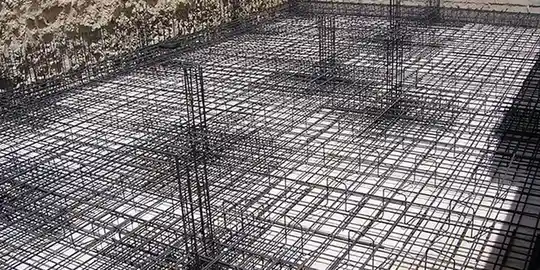
Site-specific factors
Tampa's population has grown past 400,000, driving development onto marginal land that was bypassed decades ago. The USGS karst map of Florida shows a high incidence of sinkholes in the northern part of the county. A rigid mat foundation bridges small voids that would crack a strip footing, but a void larger than the slab's structural span can cause catastrophic failure. The 2021 Piney Point incident, while in Manatee County, reminded every geotechnical engineer in the Bay area that phosphogypsum stacks and altered groundwater chemistry are regional realities. Ignoring a deep boring program here is a business-ending risk. We log every foot of recovered core, classify the material per ASTM D2487, and measure the presence of fat clays with Atterberg limits. If the limestone is pinnacled, we recommend a variable-thickness mat with deepened beams, and we confirm the design parameters with a plate load test on the prepared subgrade to verify the assumed k-value before the concrete pour.
Reference standards
ASTM D1586 (Standard Penetration Test), ASTM D2487 (Unified Soil Classification), IBC 2021 / FBC 2023 (Section 1803 & 1808), ASCE 7-22 (Minimum Design Loads), ACI 318-19 (Structural Concrete), ASTM D1194 (Plate Load Test)
Other technical services
Geotechnical Investigation for Mat Design
Deep and shallow borings, CPT soundings, and lab testing to establish soil profile, strength, and compressibility per FBC 1803 requirements.
Bearing Capacity and Settlement Analysis
Analytical and numerical calculation of allowable bearing pressure and total/differential settlement under service loads, using Tampa-specific stratigraphy.
Slab-on-Grade vs. Structural Mat Evaluation
Comparative analysis of slab options considering Tampa's water table, potential for heave, and construction cost. We quantify the trade-off between thickened edges and uniform mat depth.
Subgrade Preparation and Testing
Field density testing, proof rolling observation, and plate load tests to confirm that the prepared subgrade meets the k-value and compaction specifications before rebar placement.
Typical parameters
Common questions
What makes a raft/mat foundation different from a regular slab-on-grade in Tampa?
A standard slab-on-grade bears directly on the soil and is typically unreinforced or lightly reinforced for crack control; it's suitable for light residential loads on competent ground. A raft or mat foundation is a heavily reinforced, engineered slab designed to transmit column and wall loads to the soil while bridging weak spots. In Tampa, where we encounter loose sands, soft clays, and potential sinkholes, a mat foundation prevents the differential settlement that a simple slab cannot handle. The design requires a detailed geotechnical report with consolidation and shear strength parameters.
How deep do you investigate the soil for a mat foundation design?
The Florida Building Code requires borings to extend to a depth where the net stress increase from the foundation is less than 10% of the effective overburden stress. For a large mat in Tampa, this often means 30 to 60 feet below the base of the slab, depending on the mat width. We target the Hawthorne Formation or competent limestone as a bearing stratum. If the limestone is shallow, we core into it to check for voids; if it's deep, we ensure the overlying sand and clay can support the load without excessive consolidation settlement.
Do you account for hurricane and wind uplift in the mat design?
Yes. In Tampa, wind loads per ASCE 7-22 are part of the load combination. For tall structures, the mat foundation must resist overturning and uplift. We calculate the dead load of the mat plus the structure and compare it to the uplift forces. If the mat is below the water table, buoyancy is also considered. The geotechnical parameters we deliver—soil unit weight, friction angle, and cohesion—feed directly into the structural engineer's stability checks.
What is the typical cost range for a mat foundation design package in Tampa?
A complete geotechnical investigation and mat foundation design package for a Tampa project typically falls between US$940 and US$3,850. The final cost depends on the number of borings, lab tests required, and complexity of the analysis. A small commercial building requires less field work than a multi-story mixed-use project in the Channel District. We deliver a fixed-fee proposal after reviewing the site location and structural loads.