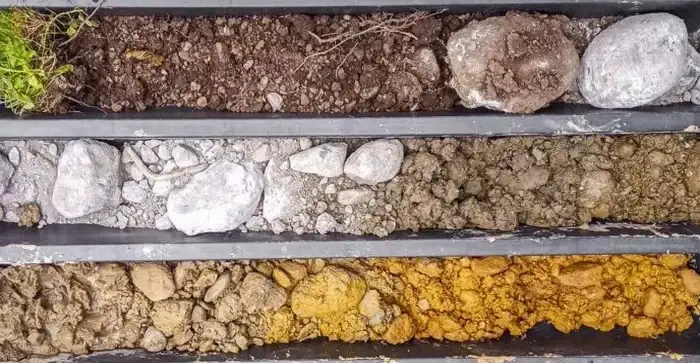
A 20-ton tracked excavator parks over the stakeout point, its bucket slicing into Tampa’s sandy surface. Within half an hour we have a clean vertical face—four, eight, sometimes twelve feet deep—exposing the sequence of natural quartz sand, shell hash, and occasional clay lenses that define the local geology. This is the exploratory test pit, the most direct method for observing soil structure without the blind spots of a borehole. When the water table sits high, as it does across much of the Tampa basin just a few feet below grade, the pit becomes a real-time window into seepage behavior and collapse potential. We log every stratum, photograph the face, and collect bag samples and undisturbed blocks for the triaxial suite back at the lab. It’s old-school fieldwork, and it still answers questions that no CPT cone ever will.
A test pit excavated to eight feet in Tampa’s surficial sands reveals more about layering, groundwater, and fill quality than three SPT borings combined.
Our approach and scope
Site-specific factors
The mistake we see repeatedly in Tampa is a contractor ordering only SPT borings on a site that was agricultural land in the 1970s. The split spoon hits refusal on a buried concrete irrigation box or a trash pit, the driller logs “refusal at six feet,” and the structural engineer designs shallow footings on what they think is competent material. An exploratory test pit would have shown the obstruction, the loose backfill around it, and the muck layer beneath. The cost difference? A day of test pit excavation versus a foundation underpinning job that runs six figures. Florida’s sinkhole-prone karst terrain adds another layer of urgency: a pit can expose the raveling zone above a cavity that a boring simply punches through without detecting the void. That’s the difference between seeing the problem and reading a misleading log.
Reference standards
ASTM D2487 – Standard Practice for Classification of Soils for Engineering Purposes (Unified Soil Classification System), ASTM D1586 – Standard Test Method for Standard Penetration Test (SPT) and Split-Barrel Sampling of Soils, IBC 2021 – Chapter 18: Soils and Foundations, ASCE 7-22 – Minimum Design Loads and Associated Criteria for Buildings and Other Structures
Other technical services
Footing verification pit
Excavated directly at the proposed column line to confirm bearing stratum continuity. We measure the actual depth to limestone or dense sand, check for organics, and collect samples for laboratory strength testing. Typically 6 to 10 feet deep, backfilled with compacted clean sand.
Utility trench exposure
Parallel pit excavated adjacent to existing underground utilities to verify embedment depth, trench backfill quality, and groundwater conditions. Critical before tying new drainage into Tampa’s stormwater network where old clay pipes may be surrounded by uncompacted sand.
Retention pond reconnaissance
Multiple pits around the perimeter of a planned stormwater pond to map the limestone surface and estimate excavation difficulty. In Tampa’s New Tampa area, the limestone can rise within three feet of the surface, turning a standard pond dig into a hammer-required operation.
Typical parameters
Common questions
How much does an exploratory test pit cost in Tampa?
For a standard single pit excavated to 8–10 feet depth with logging, photography, and sampling, the cost ranges from US$540 to US$800. The final figure depends on access conditions, the number of pits in the program, and whether undisturbed block sampling or specialized backfill is required. Projects requiring multiple pits typically see a lower per-pit cost.
What depth can you reach with a test pit in Tampa’s sandy soils?
With a 20-ton excavator and standard bucket, we reach 12 feet comfortably in Tampa’s surficial sands. Deeper than that, trench stability becomes a concern—especially when the water table is within the pit depth. For deeper investigations we switch to cpt-test or spt-drilling methods that don’t require open excavation.
Is a test pit better than a soil boring for my Tampa project?
They serve different purposes. A test pit gives you a continuous visual exposure of the soil profile—ideal for spotting fill, debris, organics, and cavities that a boring might miss. A boring gives you deeper information and SPT blow counts. For most Tampa projects under two stories, the ideal program is one or two test pits combined with spt-drilling borings to confirm conditions between pits and to greater depth.