Tampa's explosive growth from a 19th-century phosphate port into a modern Gulf Coast metropolis has pushed development into areas where the limestone bedrock is riddled with karst features. Every contractor who's broken ground in Hillsborough County knows the subsurface isn't uniform: thin sand layers drape over irregular limestone pinnacles, and the water table sits just a few feet down. When you're putting up a mid-rise in Channelside or a tilt-wall warehouse near I-75, guessing isn't an option. Our team runs CPT investigations that produce a continuous, high-resolution profile of tip resistance and sleeve friction—data you can feed directly into pile capacity calculations using LCPC or Schmertmann methods. In a city built on the edge of the Floridan aquifer, understanding exactly where that limestone drops off is the difference between a straightforward foundation and a costly re-design.
CPT doesn't just tell you what's down there—it tells you how the soil will behave under load, which is what foundation engineers in karst-prone Tampa actually need.
Our approach and scope
Site-specific factors
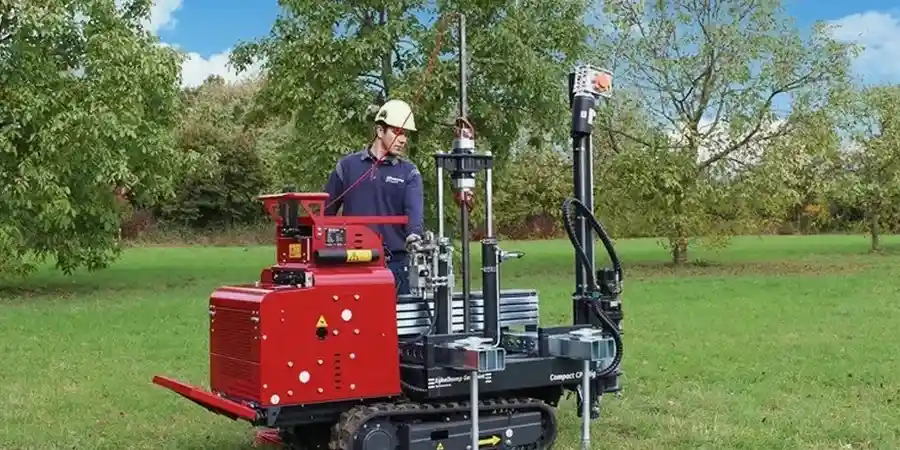
The rig we mobilize across Tampa Bay is a 20-ton truck-mounted penetrometer with hydraulic rams that can push through cemented lenses that would stop a lighter track rig cold. When we set up on a site near MacDill or out in Wesley Chapel, the first thing the operator does is level the reaction mass and check that the push rods are perfectly vertical—even a 2-degree lean in sandy soils can kink rods and ruin a profile. The biggest hazard in our area isn't the soil itself; it's hitting a void without warning. A sudden loss of tip resistance followed by a pressure drop in the hydraulic circuit means we've punched into a karst cavity, and the rods can free-fall if the operator doesn't catch it in time. That's why every CPT run in Hillsborough and Pasco counties is monitored second-by-second on screen. Our field techs have enough local track record to recognize the signature of a weathered limestone cap versus a true void, and they'll stop and backfill with grout before the hole becomes a pathway for surface water straight into the aquifer.
Video resource
Reference standards
ASTM D5778-20 (Standard Test Method for Electronic Friction Cone and Piezocone Penetration Testing of Soils), IBC 2021 Chapter 18 (Soils and Foundations), Florida Building Code 2023 Section 1810 (Deep Foundations), FHWA Geotechnical Engineering Circular No. 5 (Cone Penetration Test), ASCE 7-22 Section 20.4 (Site Classification Procedure using CPT data)
Other technical services
Seismic Piezocone (SCPTu) Testing
Downhole shear wave velocity measurement integrated with cone data—ideal for seismic site class determination per ASCE 7 and liquefaction triggering analysis in the loose sands found near Tampa's coastal areas.
Pore Pressure Dissipation Tests
We stop the cone at specified depths to record pore pressure decay curves, providing direct estimates of consolidation coefficient and permeability in the clayey layers common in estuarine deposits.
CPT-Based Pile Design Reports
Direct interpretation of cone data for axial pile capacity using LCPC, ICP, and UniCone methods—delivered as a signed and sealed report ready for permit submission.
Karst Void Detection Surveys
High-density CPT grids with real-time monitoring to map the top of limestone and identify potential voids or raveling zones before foundation construction begins.
Typical parameters
Common questions
What does a CPT test cost on a typical Tampa site?
For standard CPT soundings in the Tampa Bay area, budget between US$200 and US$230 per test location, depending on depth and whether you need seismic (SCPTu) or pore pressure dissipation add-ons. Mobilization is usually a separate line item. We deliver a flat-rate proposal after reviewing the site address and approximate depth requirements—no surprises after the fact.
How deep can you push the cone in Tampa's sandy soils?
Our 20-ton truck-mounted rig routinely reaches 80 to 100 feet in the quartz sands and clayey sands typical of Hillsborough County. The limiting factor is usually not the soil resistance but the depth to competent limestone bedrock. In areas where the Ocala Limestone is shallow—common in northern Tampa—refusal occurs at the caprock, which is exactly the information your structural engineer needs to set pile tip elevations.
Can CPT replace SPT borings for foundation design?
In many Florida site conditions, yes. CPT provides a continuous profile with superior repeatability compared to SPT, and the correlations for bearing capacity and settlement in sandy soils are well established in FHWA and IBC guidance. However, if you need soil samples for laboratory testing—such as Atterberg limits or triaxial shear on clay layers—we usually recommend a hybrid program with one or two SPT borings to recover disturbed samples alongside a full CPT grid. That gives you the best of both worlds: high-resolution stratigraphy plus lab-verified index properties.
How do you handle the CPT data for a building permit submission in Tampa?
We deliver a digital log file in standard CPT format (compatible with gINT, HoleBASE, and CPeT-IT) along with a PDF report that includes tip resistance, sleeve friction, and pore pressure versus depth plots, soil behavior type classification per Robertson (1990), and a summary table of design parameters. For projects requiring SPT N60 equivalents for geotechnical report inclusion, we deliver the conversion using Jefferies & Davies methodology. The report is signed and sealed by a Florida-licensed geotechnical engineer, ready for city of Tampa or Hillsborough County plan review. More info.